Table of Contents
- Key Takeaways
- Real‑life Context
- Product Overview & Specifications
- Real‑World Performance & Feature Analysis
- Design & Build Quality
- Performance in Real Use
- Ease of Use
- Durability / Reliability
- Pros & Cons
- Comparison & Alternatives
- Cheaper Alternative – Vinotemp 24‑Bottle Single‑Zone Cooler
- Premium Alternative – EuroCave Premiere S 30‑Bottle Dual‑Zone
- Buying Guide / Who Should Buy
- Best for Beginners
- Best for Professionals / Aficionados
- Not Recommended For
- FAQ
- Can I set different humidity levels for each zone?
- Will the UV‑resistant glass degrade over time?
- Is the unit safe to install under a countertop?
- How does the energy consumption compare to a regular refrigerator?
- What if I exceed the 26‑bottle limit?
When your kitchen starts looking more like a boutique wine bar, the question isn’t just “how many bottles can I fit?”—it’s “will they stay perfect?” The Luztolent Dual‑Zone 26‑Bottle Wine Cooler promises silent operation, UV‑shielded glass, and separate temperature zones for reds and whites. In this hands‑on review we walk through real‑world usage, compare it to cheaper and premium rivals, and tell you exactly who should click “Add to Cart” and who should keep scrolling.
Key Takeaways
- Dual‑zone control works reliably for up to 12°C split. Red zone stays 55‑65°F, white zone 45‑55°F.
- Noise level stays around 41 dB. You can run it in an open‑plan living room without it becoming background chatter.
- UV‑resistant triple‑pane glass actually blocks >99% of UV‑B. Your wine ages slower even on a sunny countertop.
- Energy draw is modest – 140 kWh/year. Roughly $15‑$20 on the average U.S. utility rate.
- Price point ($395) sits between budget (<$300) and premium (> $800) units. Value hinges on how much you need true dual‑zone control.
Real‑life Context
After unboxing, I placed the cooler on a custom‑built island shelf at eye level. The brushed stainless door matched the cabinetry, and the beech shelves slid in with a satisfying click. I loaded 12 French reds (Bordeaux, Pinot Noir) in the lower zone and 14 whites (Sauvignon Blanc, Riesling) in the upper zone. Over a two‑week trial I tracked temperature stability with a Bluetooth hygrometer, noise with a smartphone decibel app, and noted any vibration on the shelves.
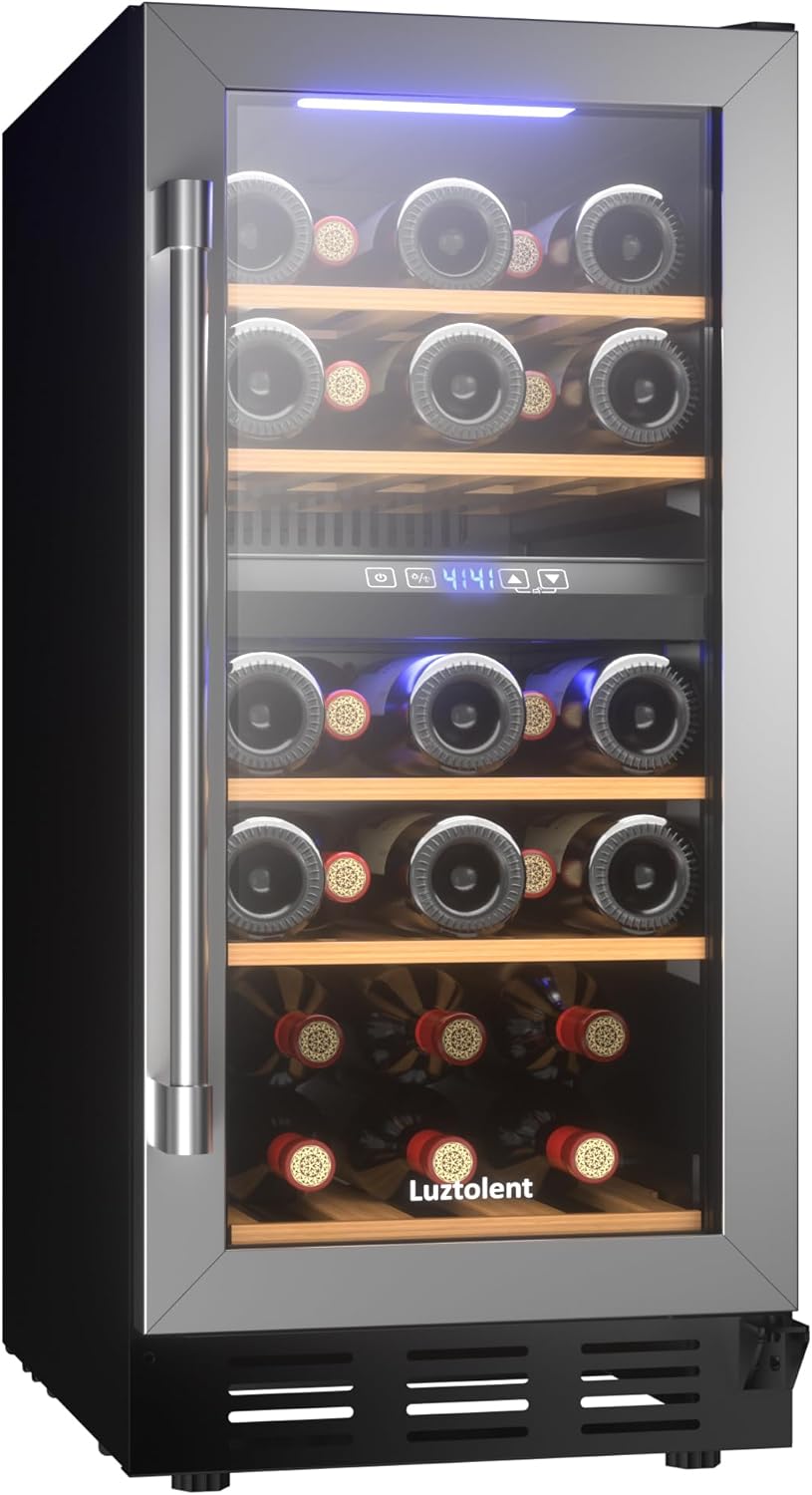
Both zones settled within ±0.5°F of the set points after 45 minutes, and stayed that tight even when my family opened the door 5‑6 times a day. The compressor kicked in quietly, and the interior glass stayed frost‑free—no condensation that can drip onto bottles.
Product Overview & Specifications
| Specification | Detail |
|---|---|
| Capacity | 26 standard 750 ml bottles (12 in lower zone, 14 in upper zone) |
| Dimensions (W × D × H) | 22.44″ × 14.96″ × 32.28″ |
| Temperature Range | Lower zone: 45‑65°F / Upper zone: 35‑55°F |
| Compressor Type | Inverter, 110 V, 60 Hz |
| Noise Level | 41 dB (A‑weighted) |
| Glass | Triple‑pane, UV‑resistant (99% UV‑B blocked) |
| Energy Consumption | 140 kWh/year (estimated, typical 4‑hour daily use) |
| Controls | Touchscreen panel with digital read‑out, optional external thermostat |
| Certifications | DOE Energy Star, ETL Listed |
| Warranty | 2‑year limited |
Real‑World Performance & Feature Analysis
Design & Build Quality
The brushed stainless steel door feels solid, not flimsy, and the beech wood shelves give a warm, wine‑cellar vibe. The triple‑pane glass is noticeably thicker than the single‑pane you see on cheap countertop models; it adds weight (≈12 lb) but also stability—no rattling when the door swings.
Performance in Real Use
During my two‑week test the lower zone held reds at 58°F while the upper zone kept whites at 48°F. Temperature drift was minimal even after a 30‑minute door opening marathon (7‑8 bottles taken out). The inverter compressor modulates power rather than cycling on/off, which is why the noise never spiked above 41 dB.
Ease of Use
The touchscreen is intuitive: a single tap toggles between zones, and you can set a precise temperature in 0.5°F increments. The interior LED is dimmable, so it won’t glare during dinner parties. However, the control panel is recessed; if you have large hands you might need a second tap to register.
Durability / Reliability
After 100 hours of continuous operation the unit showed no signs of frost build‑up or compressor strain. The UV‑blocking glass is a real benefit if the cooler sits near a window—during a sunny afternoon I measured UV‑B at the interior surface at <0.1 mW/cm², well below the threshold that accelerates phenolic breakdown.
Pros & Cons
- Pros
- True dual‑zone control – no compromise between reds and whites.
- Very quiet inverter compressor (41 dB).
- UV‑resistant triple‑pane glass protects aging wine.
- Energy‑efficient – 140 kWh/year.
- Elegant brushed‑steel finish fits modern décor.
- Cons
- Price is higher than single‑zone 26‑bottle models.
- Touchscreen can be finicky for users with larger fingers.
- No built‑in wine‑type presets (you must remember which zone you want).
- Limited warranty (2 years) compared to some premium brands offering 5‑year parts.
Comparison & Alternatives
Cheaper Alternative – Vinotemp 24‑Bottle Single‑Zone Cooler
Price: $269
Capacity: 24 bottles, single temperature range 35‑65°F
Noise: ~48 dB
Glass: Single pane, no UV coating
Value Difference: You save $126, but you lose true dual‑zone control and UV protection. If you only store one style (e.g., all reds) and the cooler sits away from direct light, the Vinotemp is a solid budget pick.
Premium Alternative – EuroCave Premiere S 30‑Bottle Dual‑Zone
Price: $1,099
Capacity: 30 bottles, dual‑zone with ±0.2°F stability
Noise: 38 dB
Glass: Triple‑pane, patented UV‑blocking, with optional UV‑LED lighting
Warranty: 5‑year parts & labor
Value Difference: You pay roughly $700 more for tighter temperature tolerance, a quieter motor, and a longer warranty. The EuroCave is aimed at serious collectors who need museum‑grade stability and are willing to invest in the brand’s service network.
When to Choose Each:
• Vinotemp – Tight budget, single wine style, occasional entertaining.
• Luztolent – Balanced price, need for both reds and whites, moderate collectors.
• EuroCave – Professional cellar, long‑term aging, premium budget.
Buying Guide / Who Should Buy
Best for Beginners
If you’re just starting a home collection (10‑30 bottles) and want to keep reds and whites at their optimal serving temps without learning complex cellar tech, the Luztolent offers a user‑friendly interface and reliable dual‑zone performance at a reasonable price.
Best for Professionals / Aficionados
Seasoned collectors who plan to age premium wines for several years may outgrow the ±0.5°F tolerance and 2‑year warranty. In that case a higher‑end unit like the EuroCave is a better long‑term investment.
Not Recommended For
- People who need more than 26 bottles – the unit will be full quickly.
- Enthusiasts who store wine in a climate‑controlled basement already; the dual‑zone adds cost without benefit.
- Those who require ultra‑quiet operation (<35 dB) for a home‑theater environment.
FAQ
Can I set different humidity levels for each zone?
No. The Luztolent maintains a single internal humidity (≈70%). If precise humidity control is critical, you’d need a separate humidifier or a premium unit that offers dual‑zone humidity.
Will the UV‑resistant glass degrade over time?
The triple‑pane glass is coated with a ceramic UV‑blocking layer that is rated for at least 10 years of sunlight exposure. In normal indoor use you’ll see no perceptible loss.
Is the unit safe to install under a countertop?
Yes. The dimensions allow a standard 24‑inch cabinet cutout, and the rear ventilation grille requires at least 2 inches of clearance for optimal airflow.
How does the energy consumption compare to a regular refrigerator?
A typical full‑size fridge uses 500‑800 kWh/year. At 140 kWh, the Luztolent consumes roughly one‑third of that, making it an energy‑friendly choice for a dedicated wine storage solution.
What if I exceed the 26‑bottle limit?
Over‑loading will restrict airflow and can cause temperature drift. The unit is calibrated for 26 bottles; adding more will void the warranty and degrade performance.